
Preparing to Confront Russia’s Shadow Fleet
Europe needs to share intelligence and exploit legal “gray zones” to tackle Russia’s sanctions-busting shadow fleet.
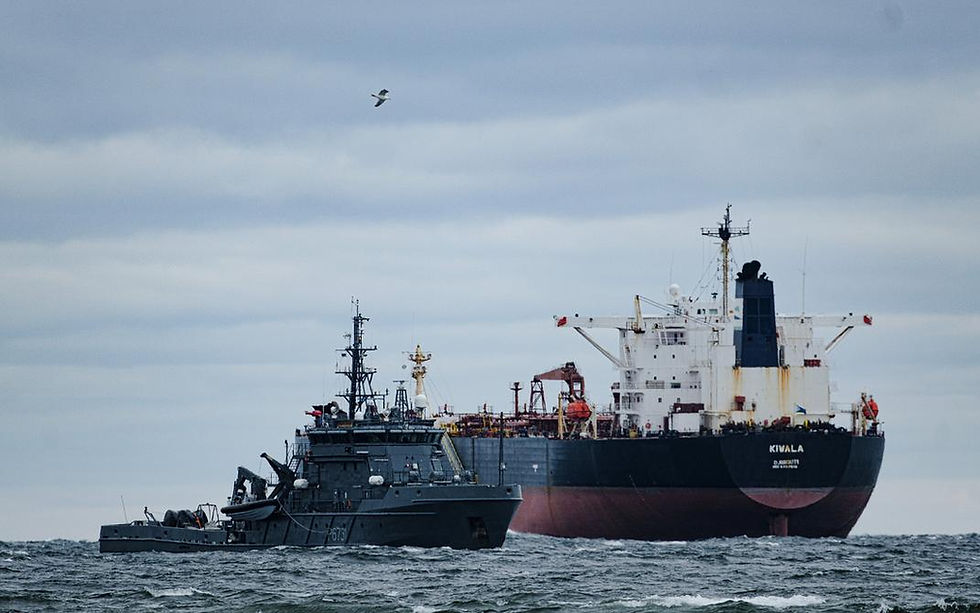
Russian shadow fleet tanker Kiwala detained off the Estonian coast between the island of Aegna and the port of Muuga, east of Tallinn, Friday, April 11, 2025. Source: Priit Mürk/ERR
The fleet, hundreds of ships strong, enables Moscow to circumvent curbs on oil sales and engage in sabotage, particularly in the Baltic, posing security, environmental, and economic challenges for Europe. So far, the continent’s response has been anemic.
The shadow fleet holds significant strategic value beyond oil transfers. Writing in Foreign Affairs, CEPA senior fellows Irina Borogan and Andrei Soldatov warned that the vessels provide both effective cover for Russian agents and convenient launch platforms for drones. The ships stand accused of involvement in drone launches to disrupt Danish airspace and internet cable-cutting operations in the Baltic Sea.
Russian intelligence has a long history of using civilian vessels for espionage, dating back to early Soviet times, and the Kremlin has invested significant resources and deployed military heavyweights to revive seaborne sabotage. These include Admiral Igor Kostyukov and Nikolai Patrushev, a former head of the Security Council and FSB.
Lea Allonier, co-founder of the Copenhagen-based Dark Waters project, which tracks Russian shadow fleet ships, says there are two core ways to examine the shadow fleet: as an environmental or a geopolitical issue. The current framework is centered around the environmental and, as many of the fleet’s vessels are old, European navies and officials have been stopping them to find any breaches of environmental rules.
But this system does not provide many opportunities for action beyond those inspections, according to Allonier. European states may have to shift to prioritizing a geopolitical approach and start detaining vessels, even if it requires operating in a legal gray zone, she said.
Since Russia is operating in a gray zone by using these ships, European countries should respond accordingly, argues Tom Sharpe, a British defense commentator and former Royal Navy spokesman. Maritime laws, while imperfect, should be adhered to, and Europe must develop a coherent system to inspect ships suspected of sanctions-busting and use existing legal loopholes to detain them.
It would require leadership and the willingness of major European governments, such as Germany, France, and the UK, for such an initiative to work. Europe is moving towards this approach, but it still lacks a unified system.
Kyiv has employed its own strategy. In the first two weeks of December, Ukrainian forces struck at least three Russian tankers that had carried illegal oil in the Black Sea (all were empty at the time). But while that is legitimate for a country at war, it cannot be used by others.
Tackling unflagged ships and sanctions infringements requires a revision of UNCLOS, the international maritime legal framework, as the existing system leaves loopholes and gray areas in which Russia operates. But changing legal conventions will take years, and Russian drones and hybrid operations are threatening European countries now. Improving European security in the meantime requires enhanced cooperation.
Much information about vessels currently gathered by states is often classified, as it has military implications, and is not shared with other capitals, Sharpe says. This needs to change if an effective tracking mechanism is to be developed.
Some Russian ships will pass inspections and comply with new standards, but it is crucial to keep them all under surveillance as they may be used for sabotage. A unified system of data-sharing must be created so European states can work together to monitor the shadow fleet.
Allonier emphasized the importance of fast information transfer in the development of a new system. It should be designed to allow quick data sharing and minimize administrative hurdles, she said.
Such cooperation must extend to non-European states, such as Panama or Cameroon, under whose flags the shadow fleet operates. It should also include non-military entities with the capacity to collect intelligence at sea, such as pilotage associations, coastguards, search and rescue, banks, insurance companies, shipping companies, and NGOs.
The shadow fleet could also offer an opportunity for the UK, in particular, to step up its engagement. While its defense sector has been underfunded for decades, the threat of hybrid warfare should push London to invest more in naval security. Notably, its maritime insurance market is very large, and it also leads the 10-nation Joint Expeditionary Force (JEF) whose members are concentrated in the Baltic region.
The UK is currently investing a large part of its defense budget in new nuclear missile-armed submarines and has little money left for other areas. But if it truly seeks military leadership in Europe, it needs to offer a more active role. The UK is less open to the threats and intimidation that Russia aims at the smaller Nordic-Baltic countries, and which have succeeded in heading off tougher action against the shadow fleet (see this CEPA article) and the Kremlin’s accelerating shadow war.
There are positive signs, including a much closer British defense relationship with Norway, which will include a £10bn ($13bn) program to build five frigates for the Norwegian navy and joint operations with the Royal Navy. Future warship orders from Denmark and Sweden are also possible.
It is true that the shadow fleet presents one of the most complex dilemmas in the hybrid confrontation between Russia and Europe. While there is no universal or straightforward answer, Europe needs to respond to Russia’s provocations since appeals to international law have failed.
Better intelligence and data sharing must be involved, and ships carefully inspected and tracked. Ultimately, when Russia goes too far — as it very likely will — the northern European democracies must be ready to use military force to check Russian lawlessness.
By Mykyta (Nikita) Vorobiov. Mykyta Vorobiov is a political analyst and a Master`s student at the University of Oxford, pursuing an MSc in Russian and Eastern European Studies. He holds a BA in Ethics and Politics from Bard College Berlin, where he conducted extensive research on Russian visual propaganda. For the last four years, Nikita has been publishing articles on politics and law for CEPA, VoxEurop, JURIST, and others. Article first time published on CEPA web page. Prepared for publication by volunteers from the Res Publica - The Center for Civil Resistance.


Comments